Jungheinrich - leading solution provider for intralogistics
Your solutions
Your solutions
Your solutions
Your solutions
Jungheinrich - leading solution provider for intralogistics
About us
About us
About us
About us
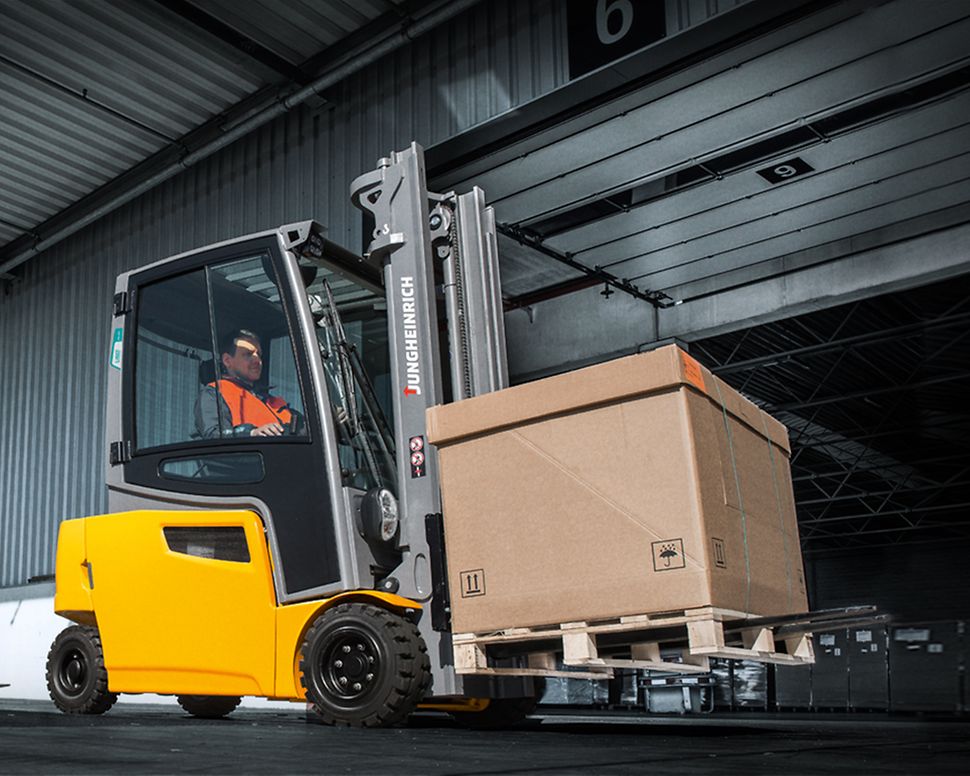
당사의 지게차는 거의 모든 창고 환경에서 활용할 수 있는 효율적인 올라운더로 입증되어 왔습니다. 강력한 성능과 높은 비용 효율성을 모두 갖춘 지게차를 찾고 계신가요? 그렇다면 Jungheinrich의 카운터밸런스 지게차가 정답입니다. 이 지게차들은 뛰어난 기동성을 갖추고 있어 실내외 어디에서든 귀하의 화물을 매우 높은 신뢰성으로 운송합니다.
이러한 이유로 당사의 다양한 지게차는 물류 및 화물 처리, 각종 저장 시스템, 식음료 생산, 건설·중공업·금속 산업, 목재 및 화학 산업 등 다양한 산업 분야에서 사용되고 있습니다.
모든 지게차는 전면에 리프팅 프레임이 있는 마스트를 장착하고 있으며, 도달 가능한 상승 높이에 따라 여러 개의 리프팅 마스트가 사용됩니다. 지게차 모터의 기계적 힘을 사용하는 유압 실린더를 통해 하중을 연속적이고 정밀하게 들어 올리거나 내릴 수 있습니다. 또한 유압 틸트 실린더를 사용하여 마스트를 전후로 기울이면서 하중의 중심을 지게차의 중심에 더 가깝게 이동시킬 수 있습니다. 이러한 구조적 특성 때문에 카운터밸런스 지게차라고 불립니다.
앞뒤 차축 사이에서 전후 이동을 통해 하중을 운반하는 리치 트럭과는 달리, 지게차의 하중 중심은 틸트 실린더가 있어도 차량 전면에 위치합니다. 이를 보완하기 위해 카운터밸런스 지게차는 무게추 원리에 따라 작동하며, 충분히 무거운 카운터웨이트가 들어 올린 하중을 균형 있게 지지해야 합니다.
전동 지게차의 경우 무거운 배터리가 이 역할을 수행하고, 디젤 및 LPG 지게차는 별도의 무게추가 필요합니다. 카운터밸런스 지게차에서 전면 차축은 지게차의 무게와 운반되는 화물 간의 균형을 유지하는 틸팅 축 역할을 합니다. 이를 통해 최대 5톤의 하중을 안전하게 들어 올리고 운반할 수 있습니다.
당사는 전동 지게차와 내연기관 지게차를 모두 제공합니다. 귀하의 창고 활용 방식에 따라 적합한 타입을 선택할 수 있습니다. 예를 들어, 협소한 보관 공간을 가진 물류 및 배송업체 또는 제조업체의 공구 창고라면 전동 지게차의 콤팩트한 설계가 최고의 성능을 제공합니다. 3상 AC 기술을 사용하는 차량은 주행 특성, 조작성, 유지 비용 면에서 탁월합니다.
PureEnergy 기술 개념은 특히 높은 에너지 효율을 제공하며, 최소한의 에너지 소비로 지속적인 고성능을 실현할 수 있도록 설계된 다양한 최적화 기능을 갖추고 있습니다. 최신 세대의 3상 AC 기술은 모터와 제어 시스템 간의 최적 조율을 통해 뛰어난 에너지 균형을 달성합니다.
PureEnergy의 추가 특징으로는 소비자와 가까운 위치 덕분에 매우 짧은 전기 배선, 그리고 유압 블록에 대한 직접 연결 덕분에 줄어든 호스 라인이 있습니다(콤팩트 유압 시스템).
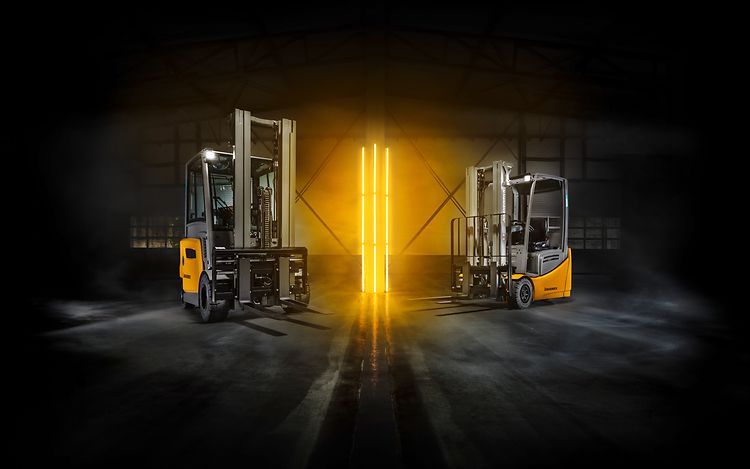
A forklift truck is a three-wheel or four-wheel industrial truck primarily used for the internal handling and transport of goods and merchandise. In contrast to simple, forklifts have their own drive and a mast, which not only allows loads to be picked up but also to be stacked.
The forklift truck is named after the fork carrier, which is usually used to pick up pallets and pallet cages. The fork carrier usually consists of two, more rarely also several steel forks, which are called fork tines. Although other types of forklift trucks also have forks, they do not belong to the forklift truck category, but are named after other, more distinct aspects, for example, the reach truck.
The typical use of forklift trucks is the handling of goods, for example loading and unloading trucks and larger vehicles. Forklifts are also used for classic internal transport, for example to supply a production facility or to store goods. They may also be used for special purposes; for example, setting up and dismantling trade fairs and events.
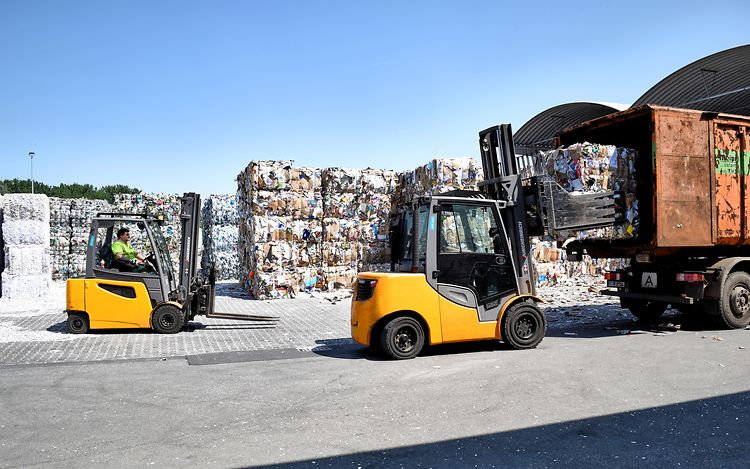
Depending on the type and application, forklift trucks are used in different areas. In general, however, forklifts are an important foundation for goods handling and transport across almost all industries. This applies to the automotive sector and the manufacturing industry as well as to the food and beverage industry and logistics companies. Forklift trucks are used both indoors (e.g. in halls and warehouses) and outdoors (e.g. on company premises, at the port or airport, or at event locations).
Depending on the type of drive, the possible application differs: Electric forklifts are suitable not only for indoor but also for outdoor use whereas gas and diesel are more difficult. Gas forklifts must meet special safety and emission regulations in order to be allowed to be used indoors. Diesel forklifts are basically only used outdoors.
How a forklift truck works depends on the type and construction of the truck. In general, however, the function is based on the so-called lifting unit, consisting of the lift mast and fork carrier. The forks of the forklift truck make it possible to place the lifting mechanism under pallets and other loads in order to lift them. These are then usually lifted for transport or stacking by means of a lifting mast, hydraulic cylinder and lifting chains. In addition to fork carriers with forks, other load handling devices such as mandrels, clamps or tippers can also be used on front loaders and other types of forklift trucks.
Forklift trucks, also known counterbalance trucks, in the strictest sense of the word are so-called front loaders, which operate according to the counterbalance principle. The forks are located at the front of the truck. The load weight picked up by the fork is balanced by a correspondingly high counterweight at the rear.
There are also other, special types of forklift trucks. These include the so-called reach truck that pushes the mast forwards and then back again to pick up the load, so that the load's centre of gravity is no longer at the front but between the truck's axles. Other forklift types are high-bay stackers, which are used to load and unload goods on a rack system in the high-bay warehouse, and order picking trucks, whose primary purpose is to collect goods according to specified orders.
The so-called pallet truck is another variant but is usually not counted among the classic forklifts. Pedestrian stackers are also called high-lift trucks and are generally considered part of the lifting truck category.
When it comes to drives, a fundamental distinction is made between forklift trucks with electric motors and with internal combustion (IC) engines.
Electromotive forklifts draw their energy from the forklift battery. Lead-acid batteries and lithium-ion batteries are used here.
With combustion engine forklifts, a distinction is made between diesel forklifts and gas or LPG forklifts. The latter are operated either with natural gas or liquid gas (LPG, Liquefied Petroleum Gas), depending on the type. Although gasoline forklifts also belong to the category of IC engine forklifts, they are rarely used in the European Union. Furthermore, a distinction is made between hydrostatic and hydrodynamic drives for IC engine trucks. Hydrodynamic drives are usually found in the simpler IC engine-powered forklifts, also known as "V-stackers", and are well suited for transport tasks. Hydrostatic drives, on the other hand, are generally associated with faster acceleration, more precise steering and easy reversing. This makes forklifts with hydrostatic drives ideal for goods handling such as loading and unloading trucks.
The advantages of electric forklift trucks include their high efficiency and versatility. Since such front forklifts are emission-free, their use is possible both indoors and outdoors. The low-noise and emission-free operation protects employees and protects the environment.
Compared with IC engine-powered vehicles, forklifts with lithium-ion batteries are particularly attractive due to their very low operating and maintenance costs.
A possible disadvantage of electric forklifts with lead-acid batteries is that the batteries may need to be exchanged more frequently when they are used for a very long time and intensively. Due to their much higher energy efficiency, however, counterbalance trucks and other types of trucks with lithium-ion batteries do not have this problem.
Furthermore, most electric-powered trucks generally require good floor conditions, especially in terms of ground clearance and protection against dust and dirt. However, Jungheinrich also develops and produces electrically powered trucks that are specially optimised for outdoor use.
For forklift trucks with electric motors, two primary types of truck batteries are used: lead-acid batteries and lithium-ion batteries. The latter offer some convincing advantages and are thus establishing themselves as the new standard. Lithium-ion batteries, for example, are better environmentally, more energy efficient and they deliver consistently good performance even when the battery is already partially discharged. They are also maintenance-free and have a long service life.
Our lithium-ion stackers form an optimally coordinated system of forklift, lithium-ion battery and charging technology.
In general, diesel and gas forklift trucks are more powerful and can therefore handle heavy loads and difficult tasks in, for example, dusty and uneven working environments. However, as a pioneer in lithium-ion technology, the electric forklifts from Jungheinrich are now so powerful that they can stand up in comparison with IC engine trucks in many cases while scoring points for greater efficiency.
Advantages of IC engine-powered trucks include being able to deal with uneven floors and that they are ready for use at all times thanks to zero charging time. The disadvantages of IC engine-powered forklift trucks are higher operating costs, more noise and greater emission values, which is why they are usually only used outdoors.
Gas forklift trucks are powered by either natural gas or LPG. LPG consists of a propane/butane mixture.
The lifting capacity of forklift trucks differs depending on the construction and drive system. Counterbalanced trucks from Jungheinrich can lift loads of up to 5 t in weight, whereby the load capacity decreases with increasing lifting height. You can find details on the load capacity of the individual truck models in our technical product sheets.
The lifting height of forklift trucks depends on various factors. Counterbalanced trucks from Jungheinrich can reach heights of up to 7.5 m. For details on the actual lifting height of the various forklift models, please refer to our technical product sheets.
The maximum travel speed of forklift trucks varies. Depending on the model, Jungheinrich counterbalance trucks can reach speeds of up to 22 km/h without load. Details of the actual travel speed with and without load can be found in our technical product sheets for the individual truck models.
Yes. As part of our special construction, you can also obtain so-called explosion-proof forklifts from our Ex-Protection Competence Centre, which fully meet your safety requirements in potentially explosive areas. Jungheinrich thus offers you safe solutions for using forklift trucks in environments with flammable gases and vapours as well as explosive powders and dusts, for example in the chemical and pharmaceutical industries.
Our explosion-protection trucks are always from the current series, hardly differ from their conventional counterparts in terms of performance and design and offer the highest ergonomic standards. Service technicians specially trained in explosion protection ensure that your explosion-protected truck remains fully operational for many years and passes all legally required tests with top marks.
Yes. Our forklifts offer maximum functional reliability even at -20 °C. They can be equipped with cold storage cabins and different types of windows as a configuration option.
Basically, all Jungheinrich trucks, whether forklift trucks, reach trucks, order pickers or high-bay stackers, have a driver's cab. For safe operation in different environments and under changing weather conditions, Jungheinrich offers forklift variants with an enclosed driver's cab.
The term "stacker" is often used synonymously with "forklift truck". However, this designation emphasises the industrial truck's ability not only to lift palletised goods but also to stack them. However, as this also applies to other industrial trucks, the general category term "forklift" includes not only the forklift in the narrower sense (i.e. the counterbalanced forklift) but also other variants such as reach trucks, high-bay stackers, order pickers and pedestrian stackers.
The term "front loader" includes all trucks where the fork carriage or forks are located at the front. In addition, the driver's seat or cab is usually facing the direction of travel. A classic forklift truck is considered a front loader.
The typical forklift truck, as it is most widely used, operates according to the so-called counterbalance principle. This means that the load weight on the forks at the front is balanced by a counterweight at the rear. When we talk about a forklift truck, we usually mean a counterbalance truck.
The term "pedestrian-controlled forklift truck" is used relatively rarely and refers to forklift trucks that are controlled by pedestrians rather than a driver. These industrial trucks are guided by a drawbar and are also called "high-lift trucks". In practice, they do not count as forklifts but as pallet trucks.
In principle, all electric motor-driven forklift trucks can be used in the warehouse. If strict safety and emission regulations are observed, gas forklifts can also be used in the warehouse in some cases. Diesel forklifts are basically always ruled out for indoor use.
For outdoor use, we recommend all IC engine forklifts such as diesel and LPG forklifts. In general, electric motor-driven forklifts are less suitable for outdoor use because they place higher demands on ground clearance and protection against dust and dirt. However, Jungheinrich also develops electrically powered forklift trucks that can cope with outdoor use without any problems.
Depending on the aisle width, different electric forklift trucks can be used in the warehouse. This is especially true for our very compact three-wheel electric forklifts in the 1 series, which have extremely compact dimensions and a width of only 990 mm – usually ideal for safe use even in narrow aisles. For the typical narrow aisle warehouse, however, reach trucks or high-bay stackers are still recommended rather than counterbalanced trucks.
You can find the corresponding user manuals for our forklift trucks as a PDF download on our operating manual search page.
You can contact our forklift truck service department to have your truck repaired at any time. We also take care of your warehouse equipment, your forklift battery and all battery chargers. Our extensive range of services covers everything from maintenance to repairs, with quick service guaranteed.
Our spare parts service provides all spare parts for your truck with the usual Jungheinrich level of quality. Availability of original spare parts is maintained at over 98 percent. Whether you need wheels, lighting or mirrors: simply select the required spare part in the online shop, order it directly and receive it within 24 hours if it is in stock.
In order to be allowed to drive a forklift truck, you need an industrial truck licence, also known as a forklift truck licence or simply truck licence. The minimum age for acquiring a licence is 18.
Young people under the age of 18 may operate industrial trucks for vocational training purposes, provided they are supervised.
In order to be allowed to drive a forklift truck and other industrial trucks on company premises, you usually need an industrial truck licence. If you want to drive a forklift truck on a public road, you need a category L driving licence.
Jungheinrich provides driver training courses based on the provisions of the German Social Accident Insurance (DGUV). Our driver training courses based on DGUV regulations ensure that your truck operators are comprehensively trained and skilled in the efficient and safe use of forklift trucks.
Are you looking for a high-performance forklift truck and wondering which one is right for your application? Regardless of whether you need an electric, diesel or gas-powered truck for stacking, lifting, towing or order picking applications, you can rely on our intelligent forklift advisor to help you find the right truck for your business.
Forklift trucks may be driven only on specified traffic routes on company premises. To drive on public roads and in car parks, the forklift truck also needs approval for road use.
The drive type also determines where the truck can be used on company premises: Gas-powered trucks used indoors must meet special safety and emission regulations.
Forklift trucks are only allowed to drive on a public road if they are approved for road use. To gain approval, they must meet certain requirements of the Road Traffic Licensing Regulations (StVZO) and the Road Traffic Regulations (StVO). This means that they must have working lighting in all areas, direction indicators, brake lights, exterior mirrors and a licence plate, among other things.
In addition to Jungheinrich, there are five other major manufacturers of forklift trucks in Germany. However, Jungheinrich is not only able to offer specialist contacts in Germany, but also in the sales and service companies in over 40 countries worldwide. Discover the benefits for yourself:
The cost of a forklift depends on the type of drive (gas, electric or diesel) as well as engine performance and equipment. The prices range from around EUR 36,000 to EUR 100,000.
Before you decide on a truck, you should consider where and what you want to use it for. Devices that are only to be used or are primarily to be used in enclosed spaces have to meet different requirements than forklifts that will also be used outdoors. For example, electric forklift trucks can be used both indoors and outdoors. Gas forklift trucks must meet special safety and emission regulations for indoor use. Whereas, diesel forklift trucks are generally only used outdoors.
You should also consider which type of forklift truck is most suitable for your application. Do you need a front stacker, a counterbalance forklift truck, a telescopic lift truck or even a reach truck? Our forklift advisor will be happy to help you make the right choice.
At Jungheinrich JUNGSTARS you will find used, professionally refurbished forklift trucks. All forklift trucks come with a 12-month warranty, just like our new models. With every Jungheinrich JUNGSTAR you also receive a comprehensive service package, such as individual financing and a trade-in for your old truck.
Find a used Jungheinrich forklift trick now with our used forklift search.
You can rent forklift trucks from our Jungheinrich Rental Service experts. Our professional rental trucks allow you to remain flexible and only pay for the truck when you need it. We offer a free-of-charge consultation and a no-obligation quotation. So why not choose the right truck for your company and your application from our range of industrial trucks.
Do you need a forklift truck for a limited, yet fairly lengthy period of time? Then our long-term rental service is perfect for you! With our all-inclusive package, we can deliver lease trucks or rental trucks that meet your exact requirements: offering flexibility, planning reliability and cost transparency. Contact us and we will be happy to help!
귀하의 차량 운용에 다양한 창고 작업을 신뢰성 있게 수행할 수 있는 고성능 지게차가 아직 없다면, 걱정하실 필요가 없습니다. 제품 문의 양식을 작성하여 당사 전문 상담사에게 연락하실 수 있습니다. 이들은 적합한 지게차를 선택하는 데 기꺼이 도움을 드립니다.
지게차를 바로 구매하지 않고, 먼저 이러한 실용적인 창고 장비의 금융 옵션에 대해 알아보고 싶으시다면, Jungheinrich의 저희 금융 상담사가 귀하를 위해 준비되어 있습니다. 상담사와 함께 귀하에게 할부 구매 또는 지게차 리스 중 어떤 것이 최적의 옵션인지 판단합니다.
또한 단기 솔루션에 대해서도 기꺼이 상담해드립니다: 수요가 급증하거나 성수기 비즈니스에서 처리 능력을 높여야 할 경우, 지게차 렌탈 상담 서비스를 통해 임시로 사용할 수 있는 렌탈 트럭을 제공합니다.
귀하의 차량 보유대에 다양한 창고 작업을 안정적으로 수행할 수 있는 고성능 지게차가 아직 없다면, 제품 문의를 통해 저희 전문 상담사에게 연락하십시오. 상담사들이 적합한 지게차 선택을 도와드립니다. 또한 융하인리히 PROFISHOP에서 귀하의 지게차 보유대용 추가 운송 및 저장 상자와 기타 지게차 액세서리도 구매하실 수 있습니다.
지게차를 바로 구매하지 않고, 먼저 이러한 실용적인 창고 장비의 금융 옵션에 대해 알아보고 싶으시다면, Jungheinrich의 저희 금융 상담사가 귀하를 위해 준비되어 있습니다. 상담사와 함께 귀하에게 할부 구매 또는 지게차 리스 중 어떤 것이 최적의 옵션인지 판단합니다.
단기적인 솔루션이 필요할 때에도 저희가 귀하의 상담 파트너입니다: 주문 급증을 처리하거나 시즌 사업에서 물류 처리 능력을 높여야 할 경우, 렌트 지게차 상담을 통해 임시 사용용 장비를 찾으실 수 있습니다.
최신 소식 받기
지금 구독하세요